
What You CAN'T Put in a Dumpster (Prohibited Items)

The list of things that can't go in a roll-off dumpster is short, and every item on it is there for one of three reasons. Missouri law bans it from landfills. The transfer station that receives our loads won't accept it. Or it can hurt somebody, usually the driver or the crew at the tipping floor. This guide goes through the whole list, explains which reason applies, and tells you where each item can go instead, with the local drop-off programs for Lincoln, St. Charles and Warren counties and the St. Louis side of the river.
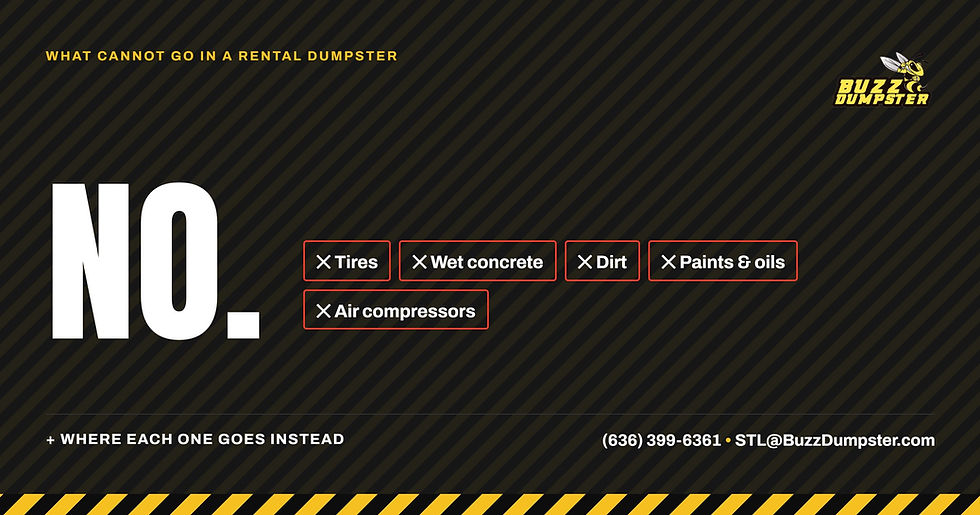
The five things that never go in a Buzz rental dumpster
Tires. Missouri bans whole tires from landfills, and the transfer stations we haul to list them as excluded (Missouri Department of Natural Resources, PUB0186, and Meridian Waste, Foristell transfer station). The fix is easy. Missouri tire retailers are required to take the tires you're replacing, and the state collects a 50-cent fee on every new tire sold (Missouri Department of Revenue, Tire and Lead-Acid Battery Fee). Take old tires to any tire shop.
Wet concrete. It sets in the can. Once it does, the steel floor has to be chipped out by hand and the can is out of service. Let it cure in a form or on a tarp, then talk to us about a heavy-debris load.
Dirt. Soil is heavy and it's excluded at the transfer station. The EPA's planning factor for dirt and sand is 929 pounds per cubic yard, so a few scoops from a skid steer would use up a two-ton allowance before anything else went in (U.S. EPA, Volume-to-Weight Conversion Factors, 2016). Dirt, sod, and gravel are a separate plan. Call before you dig.
Paints and oils. Liquids leak, oil-based products are hazardous, and waste oil has been banned from Missouri landfills since 1991 (Revised Statutes of Missouri, Section 260.250). Both go to a household hazardous waste program, covered below, with one exception for latex paint that's also covered below.
Air compressors. Pressurized tanks can rupture when a load is compacted or crushed at the transfer station. The same goes for propane cylinders, fire extinguishers, and any other sealed tank. Scrap yards take empty compressors, and propane exchanges take tanks.
Missouri's landfill bans
The state's Solid Waste Management Law set the bans that shape every dumpster company's prohibited list. As of January 1, 1991, major appliances, waste oil, and lead-acid batteries can't be disposed of in a Missouri solid waste disposal area. As of January 1, 1992, neither can yard waste, apart from a narrow exception for landfills approved to run as bioreactors that generate electricity from the gas (Revised Statutes of Missouri, Section 260.250). Whole tires are banned as well (Missouri Department of Natural Resources, PUB0186).
Major appliances. The state's definition covers refrigerators, freezers, washers, dryers, stoves, ovens, dishwashers, trash compactors, and water heaters. Microwaves were dropped from the list in 2002 and can go in the can (Missouri Department of Natural Resources, PUB0186). Anything that holds refrigerant, meaning refrigerators, freezers, and window air conditioners, also falls under federal rules that require the refrigerant to be recovered before the unit is scrapped (U.S. EPA, Stationary Refrigeration Safe Disposal Requirements). Where they go: scrap metal recyclers, the retailer delivering your new unit, or St. Charles County's Recycle Works Central, which charges $15 for refrigerators and air conditioners (St. Charles County, Recycle Works Central). This is also a category where recycling actually works. The EPA reports that of 5.25 million tons of major appliances discarded in 2018, 3.14 million tons were recycled (U.S. EPA, Durable Goods).
Lead-acid batteries. Car, truck, boat, and mower batteries. Any Missouri retailer that sells them has to accept your old one in exchange for the new one (Missouri Department of Natural Resources, PUB0186). Many auto parts stores take them without a purchase too.
Waste oil. Motor oil, transmission fluid, hydraulic oil, and fuel oil. Quick-lube shops and auto parts retailers accept used oil. Drain filters for at least 24 hours before they go in the trash (Missouri Department of Natural Resources, PUB0186).
Yard waste. Branches, brush, leaves, and grass. This one is different from the rest, because we still haul it. It goes in its own can so we can route it to composting instead of the landfill. Tell us it's a yard job when you book.
Household hazardous waste
Ordinary products such as cleaners, batteries, light bulbs, paint, pesticides, and motor oil can be dangerous if they're thrown away wrong, and the Missouri Department of Natural Resources directs residents to a permanent collection facility or a collection event run by a city, county, or solid waste district (Missouri Department of Natural Resources, Household Hazardous Waste). The EPA's list of examples is similar: paints, cleaners, oils, batteries, and pesticides (U.S. EPA, Household Hazardous Waste).
None of it goes in a dumpster. Here's where it goes around us:
St. Charles County. Recycle Works Central accepts household hazardous waste from May 1 through September 30 from county residents, at $25 for up to 50 pounds. Oil-based paint and stain are accepted as hazardous waste. Latex paint is not, and tires are not (St. Charles County, Recycle Works Central).
St. Louis County and City. The regional Household Hazardous Waste program serves residents of St. Louis County and St. Louis City (its site lists full eligibility) at two sites, one in South County and one at 4100 Seven Hills Drive in Florissant. The first 50 pounds per visit are free, additional material is $1.70 per pound, latex paint is 50 cents per pound, and you book a morning or afternoon slot in advance (HHW STL, FAQs). Appliances, tires, electronics, and construction debris are not accepted there.
Lincoln and Warren counties. The Missouri DNR keeps a calendar of collection events by region, and the solid waste management district for your county is the place to ask about the next one (Missouri Department of Natural Resources, Events, Collections and Trainings).
Batteries cannot go into a rental dumpster
Lead-acid batteries are banned by statute. Lithium-ion batteries, the ones in phones, laptops, cordless tools, e-bikes, and vapes, aren't on Missouri's ban list, and they're the ones causing fires. An EPA analysis identified 245 fires linked to lithium-ion batteries at 64 waste management facilities in 28 states between 2013 and 2020, including 139 at landfills and 15 in collection vehicles (U.S. EPA, An Analysis of Lithium-ion Battery Fires in Waste Management and Recycling, 2021). A battery crushed under a compactor or a landfill dozer goes into thermal runaway and lights whatever is around it.
Keep them out of the can. Tape the terminals and take them to a hardware store or electronics retailer with a battery drop box, or to one of the household hazardous waste programs above, which accept rechargeable batteries.
Paint cannot go into a rental dumpster: one rule for latex, another for oil
Americans buy about two gallons of paint per person each year, and more than 60 million gallons are left over annually across the country (Missouri Department of Natural Resources, Household Hazardous Waste). Most of it sits in garages until a cleanout, which is when it shows up on our driveways.
Oil-based paint, stain, varnish, and thinner are hazardous waste. They go to a collection program. Never in the can.
Latex paint is water-based and isn't hazardous once it's solid. The DNR's method: open the can, stir in shredded newspaper, sand, kitty litter, or a paint hardener from the hardware store, and leave it open to dry somewhere away from kids and pets (Missouri Department of Natural Resources, Household Hazardous Waste). Once it's fully hardened, the can with the lid off goes in regular household trash. A dried, empty paint can with no liquid left is fine in a dumpster too.
Other things that cannot go into a rental dumpster
Asbestos. Old floor tile, pipe insulation, and some siding and plaster from before the 1980s can contain it. It's excluded at the transfer station and requires licensed abatement. If you suspect it, stop and get it tested before demolition.
Medical waste and sharps. Not accepted at any transfer station. Pharmacies and hospitals run sharps and medication take-back programs.
Fluorescent bulbs and mercury items. Thermostats, thermometers, and tube lights contain mercury. The household hazardous waste programs above accept them.
Gasoline, kerosene, and solvents. Hazardous and flammable. Collection program only.
Pesticides, pool chemicals, and fertilizer. Same answer.
Railroad ties and creosote lumber. Treated with a hazardous preservative. Ask before loading, since acceptance varies by facility.
Electronics. Not banned in Missouri, but not a great fit for a landfill either. Recycle Works Central takes them for a per-item fee. Ask us before loading a pile of old TVs.
The full list of rental dumpster prohibited items:
When in doubt, send a photo
If an item isn't on this page and you're not sure, text a picture to (636) 399-6361 before you load it. It takes us thirty seconds to answer, and it saves you a pickup delay. Everything else, from the sectional to the old kitchen, is exactly what the can is for, and our what-can-go-in guide lists all of it.
Frequently asked questions about what cannot go into a rental dumpster
Can you put tires in a dumpster?
No. Missouri bans whole tires from landfills and the transfer stations we use exclude them. Take them to any tire retailer. Missouri retailers are required to accept the tires you're replacing, typically for a fee, and most will take a few extras.
Can you put paint in a dumpster?
Not liquid paint. Oil-based paint and stain go to a household hazardous waste program. Latex paint can be dried solid with kitty litter or sand, per the Missouri DNR, and then thrown in household trash with the lid off. Dried, empty cans are fine in the dumpster.
Can you put a refrigerator in a dumpster?
No. Refrigerators are on Missouri's list of landfill-banned major appliances, and federal rules require the refrigerant to be recovered before disposal. Scrap metal recyclers take them, most appliance retailers haul away the old unit on delivery, and Recycle Works Central in St. Charles County accepts them for $15.
What can you not put in a dumpster rental in Missouri?
Tires, wet concrete, dirt, paints and oils, and air compressors are out with us. State law also bans major appliances, waste oil, lead-acid batteries, whole tires, and yard waste from landfills. Yard waste can still be hauled in its own can and composted.
Can you throw batteries in a dumpster?
No. Car and mower batteries are banned from Missouri landfills and go back to any retailer that sells them. Lithium-ion batteries from phones, tools, and e-bikes aren't banned but cause fires at waste facilities, so tape the terminals and use a store drop box or a household hazardous waste program.
Where can I take household hazardous waste near Troy, MO?
St. Charles County residents can use Recycle Works Central from May through September for $25 per 50 pounds. St. Louis County and City residents have the regional HHW program, with the north site at 4100 Seven Hills Drive in Florissant and the first 50 pounds free. Lincoln and Warren County residents should check the Missouri DNR's collection event calendar for the next regional event.
Sources
• Revised Statutes of Missouri, Section 260.250 https://revisor.mo.gov/main/OneSection.aspx?section=260.250
• Missouri Department of Natural Resources, What to Do With Items Banned From Landfills (PUB0186) https://dnr.mo.gov/document-search/what-do-items-banned-landfills-pub0186/pub0186
• Missouri Department of Natural Resources, Household Hazardous Waste https://dnr.mo.gov/waste-recycling/reduce-reuse-recycle/what-to-do-with-specific/household-hazardous
• Missouri Department of Natural Resources, Events, Collections and Trainings https://dnr.mo.gov/waste-recycling/what-were-doing/events-collections-trainings
• Missouri Department of Revenue, Tire and Lead-Acid Battery Fee https://dor.mo.gov/taxation/business/tax-types/tire-battery/
• U.S. EPA, Household Hazardous Waste (HHW) https://www.epa.gov/hw/household-hazardous-waste-hhw
• U.S. EPA, Stationary Refrigeration Safe Disposal Requirements https://www.epa.gov/section608/stationary-refrigeration-safe-disposal-requirements
• U.S. EPA, An Analysis of Lithium-ion Battery Fires in Waste Management and Recycling (July 2021) https://www.epa.gov/system/files/documents/2021-08/lithium-ion-battery-report-update-7.01_508.pdf
• U.S. EPA, Durable Goods: Product-Specific Data https://www.epa.gov/facts-and-figures-about-materials-waste-and-recycling/durable-goods-product-specific-data
• U.S. EPA, Volume-to-Weight Conversion Factors (April 2016) https://www.epa.gov/sites/default/files/2016-04/documents/volume_to_weight_conversion_factors_memorandum_04192016_508fnl.pdf
• St. Charles County, Recycle Works Central https://www.sccmo.org/892/Recycle-Works---Central
• Regional Household Hazardous Waste Program (HHW STL), FAQs https://www.hhwstl.com/faqs
• Meridian Waste, Foristell Hauling and Transfer Station https://www.meridianwaste.com/mo/foristell/meridian-waste-foristell-hauling-transfer-station/


Comments