
What Can You Put in a Rental Dumpster? (Full List)

Most of what comes out of a house, a garage, or a remodel can go straight into a roll-off dumpster. The list of what can't is short, and almost every item on it is there because of a Missouri landfill rule or because it's dangerous to the driver and the transfer station crew. This guide is the long version of both lists, organized by where the stuff comes from, with the rules cited so you can check them yourself.
For scale, Americans generated 292.4 million tons of municipal solid waste in 2018, about 4.9 pounds per person per day, and half of it went to landfills (U.S. EPA, National Overview: Facts and Figures). Nearly all of that is exactly the kind of material a residential dumpster is built for.

The short answer
You can put in a dumpster: furniture, mattresses, boxes, clothing, toys, carpet, general household junk, and nearly all construction and remodeling debris including drywall, lumber, cabinets, flooring, tile, roofing shingles, siding, windows, doors, and fixtures.
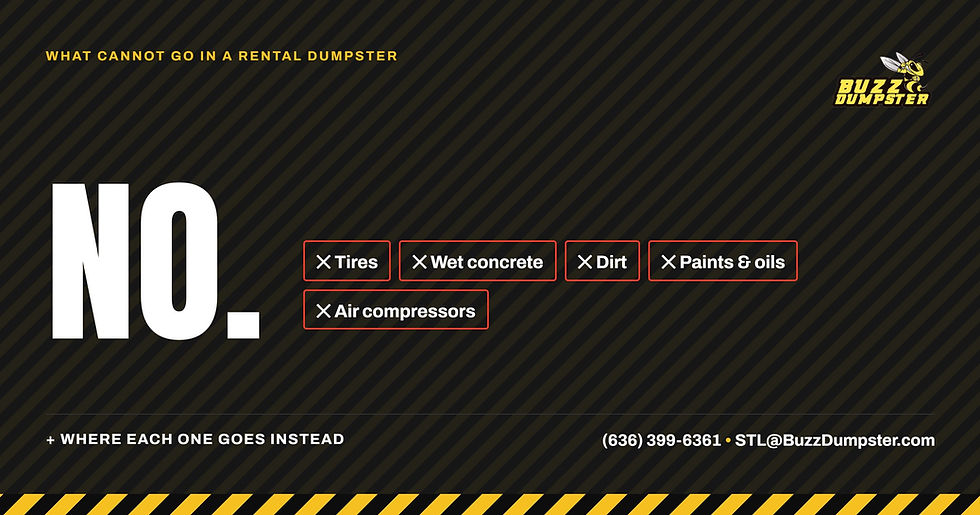
You can't put in our dumpsters: tires, wet concrete, dirt, paints and oils, and air compressors. Missouri also bans major appliances, waste oil, lead-acid batteries, whole tires, and yard waste from landfills. Yard waste is still something we haul, in its own can, so it can be composted.
Concrete, brick, and dirt are a separate plan because of the weight, never part of a mixed load.
Household junk and furniture + rental dumpster
This is the easiest category. If it lived inside your house and it isn't hazardous, it can go in the can.
• Couches, recliners, sectionals, and chairs
• Mattresses and box springs
• Dressers, desks, bookcases, tables, and bed frames
• Rugs, carpet, and padding
• Clothing, linens, curtains, and textiles
• Toys, books, and paper
• Dishes, cookware, and small kitchen items
• Lamps, mirrors, and picture frames
• Plastic storage bins, laundry baskets, and hangers
• Cardboard, packaging, and moving boxes
• Holiday decorations and artificial trees
• Exercise equipment (treadmills, weight benches)
• Grills with the propane tank removed
• Bicycles, strollers, and car seats
Furniture shows up in nearly every cleanout, and it's the item most worth trying to donate first. The EPA counted 12.1 million tons of furniture and furnishings in the 2018 waste stream, with 80 percent landfilled and less than one percent recycled (U.S. EPA, Durable Goods: Product-Specific Data). If a piece is still usable, a charity pickup takes it off your hands for free. If it isn't, break it down flat and it takes a fraction of the room in the can.
Construction and remodeling debris + rental dumpster
A residential remodel produces the same materials as a demolition site, just less of it. The EPA estimated 600 million tons of construction and demolition debris in the U.S. in 2018, more than twice the amount of municipal solid waste, and the materials it tracks are steel, wood products, drywall and plaster, brick and clay tile, asphalt shingles, concrete, and asphalt concrete (U.S. EPA, Construction and Demolition Debris: Material-Specific Data). All of the light ones can go in a Buzz can. The heavy ones need their own plan.
Goes in a regular can:
• Drywall, plaster, and lath
• Lumber, trim, studs, and plywood
• Cabinets, vanities, and countertops (laminate, wood, solid surface)
• Flooring: hardwood, laminate, vinyl, tile, and carpet
• Roofing shingles and underlayment (book it as a roofing job so the weight allowance matches)
• Siding, gutters, and soffit
• Windows, doors, and screens
• Sinks, toilets, tubs, and shower surrounds
• Light fixtures, ceiling fans, and non-hazardous electrical debris
• Insulation, bagged
• Fencing, decking, and pergola lumber
Needs a separate plan because of weight:
• Concrete, including broken slabs, footings, and pavers
• Brick, block, and stone
• Dirt, sod, gravel, and sand
• Asphalt
The reason is arithmetic. The EPA's planning factors put concrete at 860 pounds per cubic yard, dirt and sand at 929, and rock and gravel at 999, against 250 to 300 pounds for loose household waste (U.S. EPA, Volume-to-Weight Conversion Factors, 2016). Four cubic yards of concrete in the bottom of a can is already close to a two-ton allowance. Tell us before demolition starts and we'll quote it as a heavy-debris job.
Wet concrete is the one construction material that can't go in at all. It bonds to the steel floor and the can is out of service until it's chipped out.
Yard and outdoor items + rental dumpster
Structures and hardscape debris go in a regular can. Living material does not, and that's a state rule rather than a company one.
Goes in a regular can:
• Fence panels, posts, and gates
• Deck boards, railings, and stairs
• Sheds and playsets, broken down
• Patio furniture and umbrellas
• Hot tub shells, cut down
• Above-ground pool liners and frames
• Lattice, trellises, and planters (emptied of soil)
Goes in a yard waste can:
• Branches, limbs, and brush
• Leaves and grass clippings
• Shrubs and root balls (soil knocked off)
• Christmas trees
Missouri has prohibited yard waste from solid waste disposal areas since January 1, 1992, with a narrow exception for landfills that run as approved bioreactors generating electricity (Revised Statutes of Missouri, Section 260.250). That's why yard debris gets its own can with us and goes to composting. It's still a Buzz service, it just can't ride with the couch.
Appliances and electronics + rental dumpster
Major appliances stay out of the dumpster. Missouri bans them from landfills, and the state's list is specific: refrigerators, freezers, washers, dryers, stoves, ovens, dishwashers, trash compactors, and water heaters. Microwaves were removed from the list in 2002 (Missouri Department of Natural Resources, PUB0186). Refrigerators, freezers, and window air conditioners carry a second layer of federal rules. The EPA requires refrigerant to be recovered before final disposal, and the last handler in the chain, such as a scrap yard, is responsible for making sure that happened (U.S. EPA, Stationary Refrigeration Safe Disposal Requirements).
The good news is that appliances are the one waste category with a real recycling rate. Of the 5.25 million tons of major appliances discarded in 2018, 3.14 million tons were recycled (U.S. EPA, Durable Goods). Scrap metal yards take them, many retailers haul away the old unit when they deliver a new one, and St. Charles County's Recycle Works Central accepts them with a $15 fee for refrigerators and air conditioners (St. Charles County, Recycle Works Central).
Microwaves and small appliances (toasters, vacuums, coffee makers) can go in the can.
Electronics are a gray area. TVs, monitors, and computers aren't on Missouri's landfill ban list, but transfer stations and haulers handle them differently, and recycling is the better route. Recycle Works Central takes electronics for a fee that varies by item (St. Charles County, Recycle Works Central). Ask us before you load a stack of old TVs and we'll tell you the cleanest option.
Automotive and shop items + rental dumpster
Goes in a regular can:
• Car parts that hold no fluids: seats, bumpers, trim, wheels with the tire removed
• Hand tools, broken power tools, and workbenches
• Empty, dry paint cans with the lid off
• Empty fuel cans that have aired out
Stays out:
• Tires. Missouri bans whole tires from landfills, and tire retailers are required to take back the tires you're replacing (Missouri Department of Natural Resources, PUB0186). Missouri also collects a 50-cent fee on every new tire sold (Missouri Department of Revenue, Tire and Lead-Acid Battery Fee).
• Lead-acid batteries. Landfill-banned since 1991. Any retailer that sells them has to accept your old one in exchange.
• Motor oil, transmission fluid, hydraulic oil, and antifreeze. Waste oil is landfill-banned, and quick-lube shops and auto parts stores take it back.
• Air compressors, propane tanks, and other pressurized cylinders. These can rupture in a compactor.
• Gasoline, solvents, and wet paint. See the prohibited items guide for where each one goes.
A room-by-room cheat sheet of dumpster rental items
How much of it fits in a rental dumpster
A cubic yard is a 3-foot cube, about six 33-gallon trash bags or a little under half a heaped pickup bed. A 15 yard dumpster holds roughly 90 bags or six pickup loads. A 20 yard dumpster holds roughly 120 bags or eight loads. Both sit on the same 14 by 7 foot footprint. When you're not sure which one, take the 20. The price step is small and a second haul isn't.
If your load is mostly the light stuff on this page, room runs out before weight does. If it's mostly drywall, tile, or shingles, weight runs out first. Our weight limits guide explains how the two-ton allowance works, and the loading guide shows how to get the most out of the room you have.
Still not sure about something?
Text a photo to (636) 399-6361. Most of the time the answer is yes, it can go in, and when it isn't we'll tell you exactly where it should go instead.
Frequently asked questions about dumpster rentals
Can you put a mattress in a dumpster?
Yes. Mattresses and box springs are fine in a Buzz dumpster. Stand them on edge against the wall so they don't eat floor space.
Can you put appliances in a dumpster?
Small ones, yes. Major appliances, no. Missouri bans refrigerators, freezers, washers, dryers, stoves, ovens, dishwashers, trash compactors, and water heaters from landfills, so they go to a scrap metal recycler or a retailer take-back program instead. Microwaves came off the state's list in 2002 and can go in the can.
Can you put carpet in a dumpster?
Yes. Carpet and padding both go in. Roll it, tape it, and lay the rolls along the floor or walls. The EPA's planning figure for carpet is 147 pounds per cubic yard, so it's one of the lightest things you'll load.
Can you throw drywall in a dumpster?
Yes. Drywall, plaster, and lath all go in a regular can. It's heavier than it looks, about 467 pounds per cubic yard by the EPA's planning factors, so a full can of nothing but drywall will pass a two-ton allowance. Tell us it's a drywall-heavy job and we'll quote the tonnage to match.
Can you put yard waste in a dumpster?
In its own can, yes. Missouri has banned yard waste from landfills since 1992, so branches, leaves, and brush go in a separate yard waste can and get composted. Fence panels, decking, and sheds can go in a regular can.
What can you put in a roll off dumpster from a garage cleanout?
Nearly everything: shelving, workbenches, bikes, boxes, old furniture, broken tools, lawn chairs, and bagged sweepings. Set aside paint, oil, car batteries, tires, and propane tanks for the proper drop-off, and drain fuel from mowers before they go in.
Sources
• U.S. EPA, National Overview: Facts and Figures on Materials, Wastes and Recycling https://www.epa.gov/facts-and-figures-about-materials-waste-and-recycling/national-overview-facts-and-figures-materials
• U.S. EPA, Durable Goods: Product-Specific Data https://www.epa.gov/facts-and-figures-about-materials-waste-and-recycling/durable-goods-product-specific-data
• U.S. EPA, Construction and Demolition Debris: Material-Specific Data https://www.epa.gov/facts-and-figures-about-materials-waste-and-recycling/construction-and-demolition-debris-material
• U.S. EPA, Volume-to-Weight Conversion Factors (April 2016) https://www.epa.gov/sites/default/files/2016-04/documents/volume_to_weight_conversion_factors_memorandum_04192016_508fnl.pdf
• U.S. EPA, Stationary Refrigeration Safe Disposal Requirements https://www.epa.gov/section608/stationary-refrigeration-safe-disposal-requirements
• Revised Statutes of Missouri, Section 260.250 https://revisor.mo.gov/main/OneSection.aspx?section=260.250
• Missouri Department of Natural Resources, PUB0186 https://dnr.mo.gov/document-search/what-do-items-banned-landfills-pub0186/pub0186
• Missouri Department of Revenue, Tire and Lead-Acid Battery Fee https://dor.mo.gov/taxation/business/tax-types/tire-battery/
• St. Charles County, Recycle Works Central https://www.sccmo.org/892/Recycle-Works---Central
• Buzz Dumpster, What Size Rental Dumpster Do I Need? https://www.buzzdumpster.com/post/rental-dumpster-size-guide


Comments