
How to Load a Dumpster the Right Way (Maximize Space)

A roll-off rental dumpster gets full in one of two ways. Either it runs out of room, or it runs out of weight. Loading it well means pushing both limits back as far as they'll go, and the difference between a good load and a sloppy one is often a whole second haul.
Our two sizes are shaped a little differently than what you may have seen elsewhere. The 15 yard dumpster and the 20 yard dumpster are both 14 feet long and 7 feet wide, about 98 square feet on the ground. The 15 has walls 5 feet 6 inches tall, and the 20 has walls 6 feet tall. That short, tall shape is what lets them fit on a driveway in Lake St. Louis or Old Town Florissant without spilling into the street. It also means you can't just toss things over the side all day. The loading order below is written for that shape, and it works for any roll-off.

Organize how to load a dumpster before it arrives
Sort first, load second. Split what's going out into three piles: heavy and flat (concrete pavers, tile, plywood, doors, countertops), bulky and hollow (furniture, cabinets, appliances that are allowed, boxes), and loose (bags, small debris, insulation). You'll load in that order.
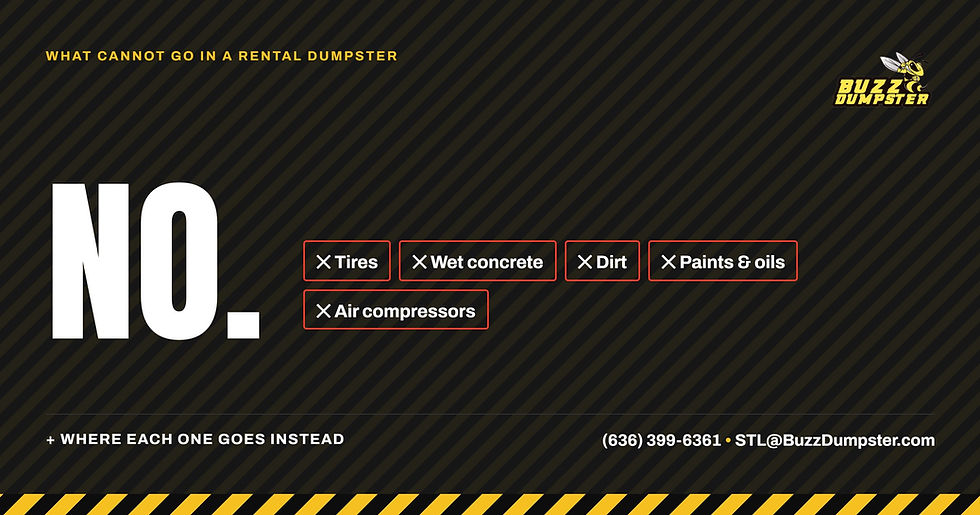
Pull out anything that can't go in. Tires, wet concrete, dirt, paints and oils, and air compressors don't go in our cans, and Missouri law keeps major appliances, waste oil, lead-acid batteries, and yard waste out of landfills (Revised Statutes of Missouri, Section 260.250). Our prohibited items guide has the full list. Yard waste is still something we haul, it just goes in its own can so it can be composted instead of landfilled.
Clear the drop spot. The truck needs about 60 feet of straight approach and 12 feet of overhead clearance to set the can down, and it sits on skid plates under the wheels so it doesn't mark the concrete. Move cars, trailers, and basketball hoops the night before.
Step 1: Open the door and walk the heavy stuff in
The swing door on the back of the can is the whole reason a 6 foot wall isn't a problem. Open it, and carry the heaviest, flattest items in first: solid doors, countertops, sheets of plywood, tile, bundles of shingles. Lay them flat on the floor, edge to edge, like you're tiling it.
This does two jobs. It puts the weight at the bottom where the truck wants it, and it builds a level platform that everything else stacks on cleanly. A can with a lumpy floor of couch cushions and broken chairs wastes a foot of height before you've put anything real in it.
Step 2: Break down everything that has air in it
Volume is what you're paying for, and most household junk is mostly air. A dresser is a box of empty drawers. A sectional is six cubic feet of frame wrapped in twenty cubic feet of foam. Take ten minutes with a drill, a reciprocating saw, and a hammer, and the same pile gets a lot smaller.
The EPA's own planning figures show how much air is in a typical load. Loose residential waste runs about 250 to 300 pounds per cubic yard, while mixed construction and demolition debris runs about 417 pounds per cubic yard, and clean gypsum board 467 (U.S. EPA, Volume-to-Weight Conversion Factors, 2016). The denser the pile, the more of your rental you actually use.
Break down:
• Dressers, desks, and cabinets: pull the drawers, knock the backs off, stack the panels flat.
• Couches and chairs: cut the fabric, pull the cushions, break the frame down to sticks.
• Box springs: cut the fabric and fold the frame.
• Cardboard: flatten every box. A stack of flat boxes takes a tenth of the room.
• Doors, shelving, and long lumber: cut to 6 feet or less so it lies flat instead of leaning.
Step 3: Line the walls with long, flat pieces
Once the floor is down, stand long items against the walls: mattresses on edge, doors, headboards, sheets of drywall, fence panels. They take almost no floor space this way, and they turn the walls into a smooth bin that loose material fills without gaps.
Keep them inside the rim. Anything leaning above the top edge has to come back out before pickup.
Step 4: Fill the middle, and fill the hollows
Now the bulky, hollow items go in the middle, tightest first. Nest what nests: small boxes inside big ones, buckets inside buckets, drawers filled with loose debris before they go in. Bagged material goes into every gap around the furniture. Think of it as pouring gravel into a jar of rocks.
Two small habits make a big difference. Bag insulation, sawdust, and small debris instead of shoveling it loose, so it packs into corners instead of sliding to the bottom. And put breakable trash (lamps, glass, old windows) in the middle of the load where it can't cut anyone at the door.
Step 5: Spread the weight front to back
A roll-off truck lifts the can from one end and drags it up onto the rails. If all the concrete pavers are at the door end and the far end is couch cushions, the can rides badly and the driver may have to redistribute it before it can move. Aim for the same density across the floor, then build up evenly.
If you're loading heavy debris (roofing, plaster, tile), spread it across the whole floor as the first layer rather than piling it in one end. That's better for the truck and it keeps you from stacking a heavy pile that shifts.
Step 6: Stop at the dumpster rim
The fill line is the top edge of the wall. Nothing above it, nothing hanging over the side. The reason is on the road, not in your driveway. Missouri law requires any vehicle carrying material that could fall off to be covered or secured so nothing can come loose in transit, and a violation is a class C misdemeanor (Revised Statutes of Missouri, Section 307.010). Drivers tarp the can before they pull out, and a tarp can't do its job over a mound. A driver who arrives to an overfilled can will ask you to pull it level, which is a lot less fun after everything's packed.
The rim rule is also where the 15 versus 20 decision pays off. The 20 yard dumpster gives you six more inches of wall for the same driveway space, and for most whole-house or whole-floor cleanouts that six inches is the difference between one haul and two. If you're torn, take the 20.
The weight side of the problem
Every rental includes a weight allowance. Ours includes two tons, and overage is billed per ton at the rate in your quote. Volume rarely gets you there on household junk. Dense material does, and it does it fast.
Using the EPA's conversion factors and our nominal capacities, here's what 20 cubic yards of a single material would weigh if you filled a 20 yard dumpster with nothing else (U.S. EPA, Volume-to-Weight Conversion Factors, 2016):
That's why concrete, brick, and dirt are a separate plan with us rather than something you mix into a household load, and why a roofing job should be quoted as a roofing job. A 20 yard dumpster a quarter full of shingles is already past a two-ton allowance. If your project is heavy, tell us when you book and we'll quote it with the right tonnage instead of surprising you at pickup. Our weight limits guide goes deeper on how overage works.
Lift with your legs, and with a friend
The National Institute for Occupational Safety and Health uses 51 pounds as the load constant in its lifting equation, the most a healthy adult should lift under ideal conditions before the recommended limit starts dropping for reach, height, twisting, and repetition (NIOSH, Applications Manual for the Revised NIOSH Lifting Equation, Publication 94-110). A loaded dumpster day is nothing but bad conditions: reaching over a wall, twisting to drop, and doing it 200 times. Team-lift anything over about 50 pounds, use a hand truck to the door, and take breaks. Gloves and closed-toe shoes are the minimum. Nobody, especially kids, climbs inside the can to stomp it down.
Loading by project
Garage cleanout. Shelving and workbenches broken down first, flat on the floor. Then bikes, mowers (drained), and boxes. Bag the loose hardware and sweepings last. One 15 yard dumpster usually does it.
Kitchen remodel. Countertops and cabinet boxes flat on the floor, cabinet doors and drywall along the walls, then flooring and trim. Keep the old fridge and dishwasher out. Major appliances are landfill-banned in Missouri and go to a scrap metal recycler instead (Missouri Department of Natural Resources, PUB0186).
Roofing. Shingles are all weight and no volume. Spread them across the whole floor, keep the load level, and expect the tonnage to matter more than the size. Book it as a roofing job so the allowance matches.
Yard and storm cleanup. Branches, leaves, and brush go in their own yard waste can so we can route them to composting, which Missouri law has required since 1992. Fence panels, old decking, and rotted lumber can go in a regular can.
Ready to load?
Book the size that fits the job, and if you're between sizes, take the 20 yard dumpster. It costs no extra driveway. Call or text (636) 399-6361 and we'll have it there the next day.
Frequently asked Dumpster Rental Questions
What is the best way to load a dumpster?
Heavy and flat items go in first through the door and lie flat across the floor. Long items stand on edge against the walls. Broken-down furniture and boxes fill the middle, and bagged loose debris fills the gaps. Keep the weight spread evenly front to back and stop at the rim.
How high can you fill a dumpster?
To the top edge of the wall and no higher. Missouri requires loads to be secured or covered so nothing can fall off in transit, so the driver tarps the can before leaving. A load above the rim can't be tarped and will need to be leveled before pickup.
Can you fill a dumpster past the top?
No. Anything above the rim or hanging over the sides has to come out before the truck can take it. If you're running out of room, break down what's in there, or call us about a swap.
Should I break down furniture before putting it in a dumpster?
Yes, if you want your money's worth. Furniture is mostly air. Pull drawers, knock off backs, cut couch fabric and cushions loose, and stack the panels flat. A dresser broken down takes a fraction of the space of a dresser standing up.
How do you load a dumpster with a tall wall?
Use the door. Our 15 yard dumpster has a 5 foot 6 inch wall and the 20 yard dumpster has a 6 foot wall, so the swing door on the back is how the heavy stuff gets in. Walk it in with a hand truck, lay it flat, and once the floor is built up, lighter items can go over the side.
How much weight can a 20 yard dumpster hold?
Every rental with us includes two tons, and overage is billed per ton at the rate in your quote. Twenty cubic yards of loose household junk usually weighs 2.5 to 3 tons by the EPA's planning figures, while 20 cubic yards of shingles would weigh around 7 tons, so heavy materials should be quoted as their own job.
What happens if I overload a dumpster?
If it's overweight, the overage in your quote applies per ton. If it's overfilled above the rim, the driver can't tarp it and will ask you to level it before it leaves. Loading evenly and stopping at the rim avoids both.
Sources
• U.S. Environmental Protection Agency, Volume-to-Weight Conversion Factors (April 2016) https://www.epa.gov/sites/default/files/2016-04/documents/volume_to_weight_conversion_factors_memorandum_04192016_508fnl.pdf
• Revised Statutes of Missouri, Section 307.010 (loads which might become dislodged to be secured) https://revisor.mo.gov/main/OneSection.aspx?section=307.010
• Revised Statutes of Missouri, Section 260.250 (disposal restrictions) https://revisor.mo.gov/main/OneSection.aspx?section=260.250
• National Institute for Occupational Safety and Health, Applications Manual for the Revised NIOSH Lifting Equation (Publication 94-110) https://www.cdc.gov/niosh/publications/numbered/94-110.html
• Missouri Department of Natural Resources, What to Do With Items Banned From Landfills (PUB0186) https://dnr.mo.gov/document-search/what-do-items-banned-landfills-pub0186/pub0186
• Buzz Dumpster, Dumpster Rentals (sizes, 14-day rental, 2-ton allowance) https://www.buzzdumpster.com/dumpsters
Buzz Dumpster, What Size Rental Dumpster Do I Need? https://www.buzzdumpster.com/post/rental-dumpster-size-guide


Comments